
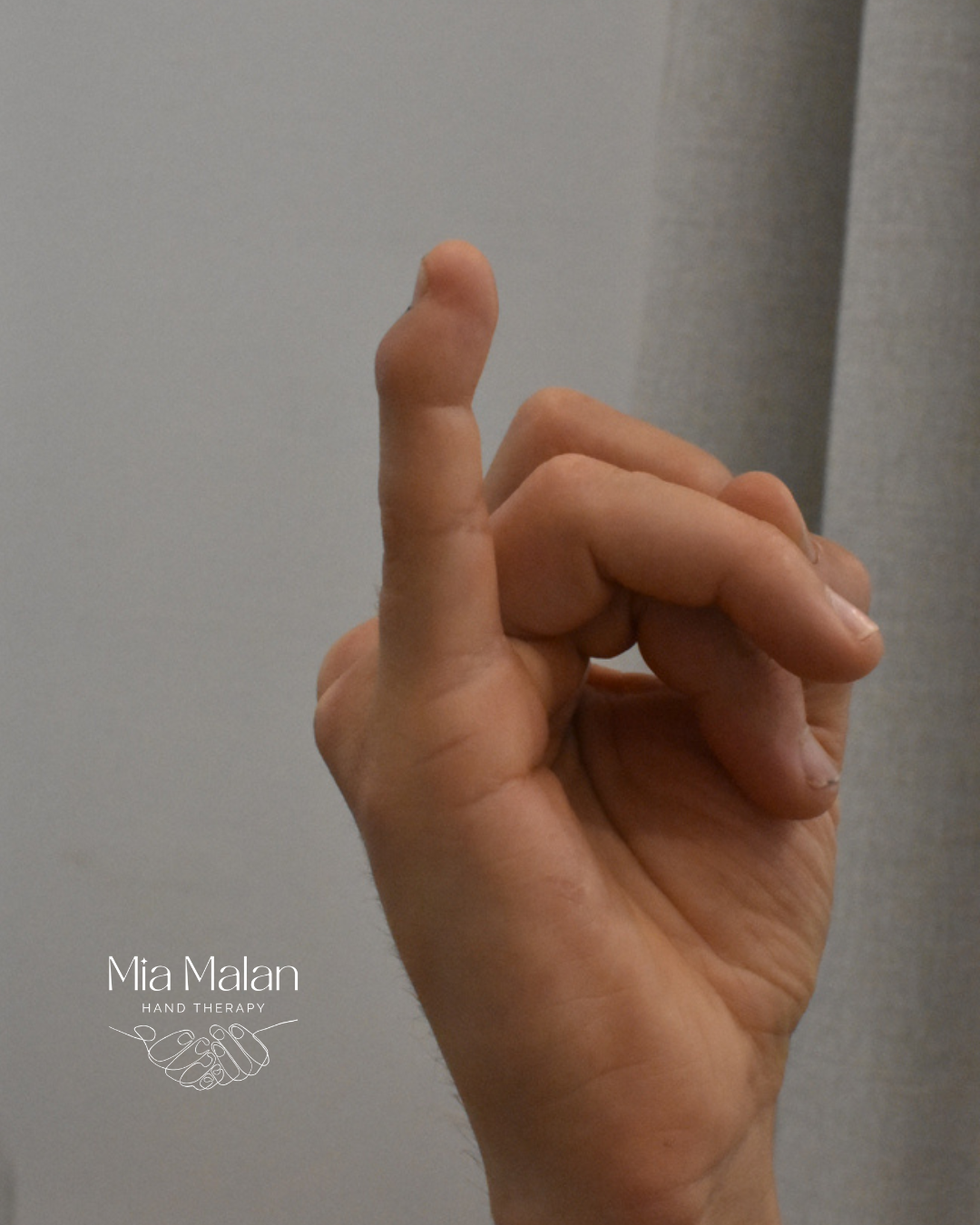
It happens in an instant. A ball hits the end of your finger. You jam it catching a door. You pull back the fitted sheet. And suddenly, your fingertip won't straighten — it just hangs there, drooping, no matter how hard you will it to move.
That's mallet finger. And in my experience as a hand therapist, it's one of the most underestimated injuries I see.
People walk in days — sometimes weeks — after the initial injury, having convinced themselves it was "just a jam." By the time they arrive, the window for the smoothest possible recovery is already narrowing. So let me tell you what I wish every patient knew from day one.
What Is Mallet Finger?
Mallet finger is an injury to the extensor digitorum tendon — the tendon that runs along the top of your finger and allows you to actively straighten the tip joint (known as the DIP joint, or distal interphalangeal joint).When this tendon is torn away from the bone, the muscle that bends your fingertip becomes completely unopposed. The result is that characteristic droop: a fingertip resting in flexion that you simply cannot lift on your own.It's a small tendon. But it does a very specific job, and when it fails, you notice immediately.
How Does It Happen?
The most common culprit is sport — specifically, a ball striking the tip of an extended finger. Basketball, netball, cricket, and volleyball are frequent offenders. But mallet finger doesn't discriminate. I've treated patients who injured themselves making their bed, catching a bag strap, or simply reaching into a cupboard at an awkward angle.It doesn't always hurt dramatically in the moment. Sometimes there's significant pain and swelling; other times, it's surprisingly mild. The droop is the giveaway.
Two Types: Soft Tissue and Bony
Not all mallet fingers are the same, which is why an X-ray is an essential first step.
Soft tissue mallet finger the tendon tears at or near its attachment point, but there's no fracture.
Bony mallet finger (or avulsion fracture) involves a fragment of bone being pulled away from the distal phalanx along with the tendon. This needs careful assessment, because the size of the fragment and the position of the joint influence treatment decisions.
In both cases, the vast majority of patients are managed conservatively — meaning no surgery. But there's an important exception: if the joint has subluxed (shifted out of position) and cannot be corrected with splinting alone, surgical consultation is warranted. For most people, though, the answer is a well-fitted splint and a lot of patience.
The 8-Week Rule
Here is the most important thing I tell every mallet finger patient, and I say it clearly, more than once: The splint cannot come off for 8 weeks outside of your weekly hand therapy checks. The DIP joint must be held in full extension — completely straight — continuously, for the tendon to reattach and heal. That means wearing the splint to shower, to sleep, to exercise, to work. The only time the splint comes off is when your hand therapist changes it for a skin check. And that changeover is done carefully, with the fingertip kept straight the entire time.
Why so strict? Because even a single moment of flexion — one brief bend of that fingertip — can pull the healing tendon away from the bone and set the process back to zero. Eight weeks, restarted. I know it sounds extreme. But this is one of those situations where the evidence is unambiguous, and where patient compliance is genuinely the biggest factor separating a good outcome from a poor one.
What Treatment Actually Looks Like
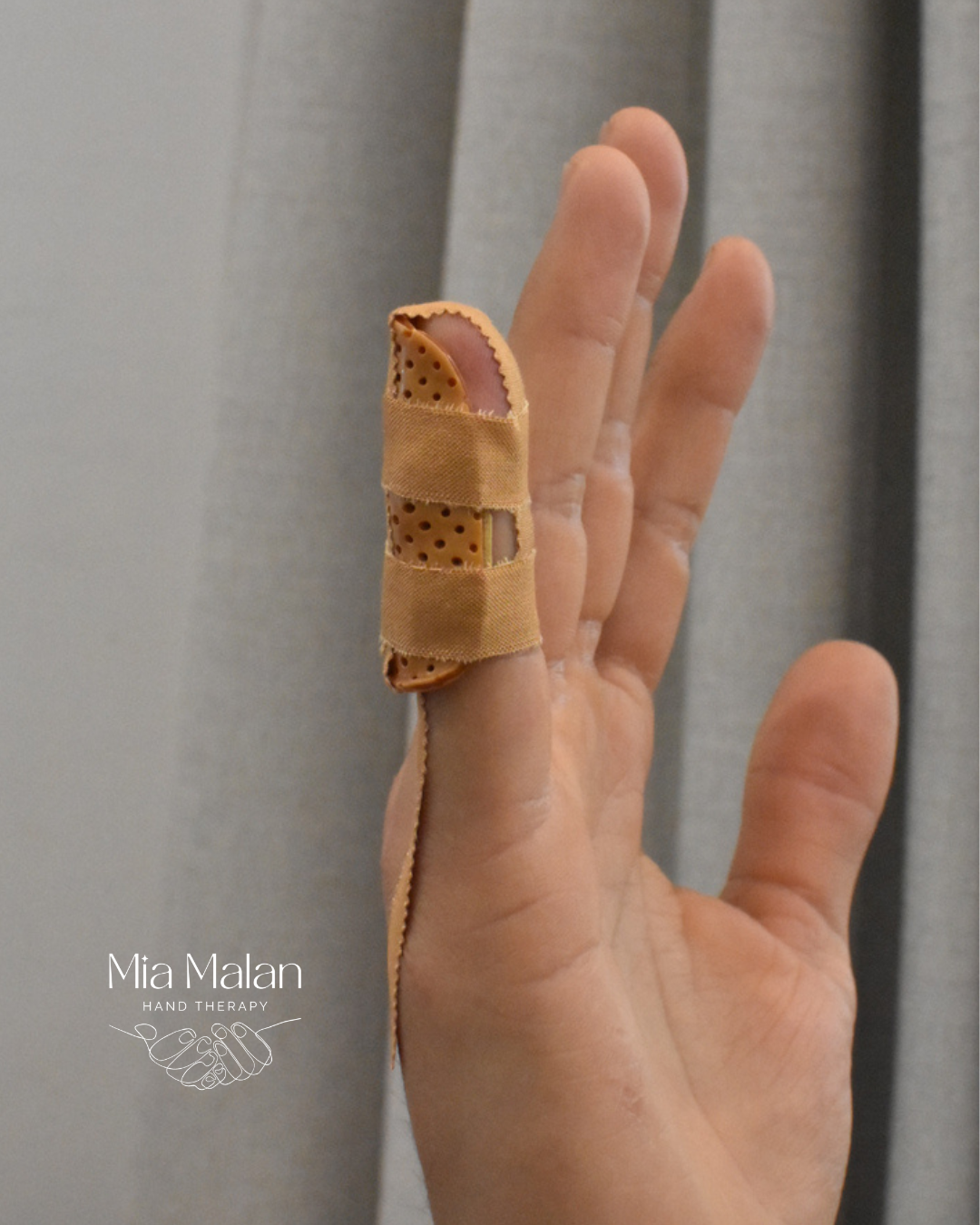
When you come in for an initial assessment, I'll take a thorough history of how the injury happened and how long ago. We'll look at the X-ray together, assess the degree of droop, check for any subluxation, and discuss which type of splint will suit your finger, your lifestyle, and your work.The splint holds your DIP joint in a neutral extended position while leaving your middle knuckle (PIP joint) completely free to move. This is important — keeping the rest of your hand active during recovery makes a real difference to your overall function.
Phase 1 (Weeks 0–8):
Full-time protection.
The DIP joint is splinted 24 hours a day. I'll see you regularly through this period to monitor your skin, check the position of the joint, and adjust the splint as needed. Your job is to keep your other fingers moving, and to protect that splint from moisture and impact.
Phase 2 (Weeks 8–10): Careful weaning. If the tendon has healed well with no extensor lag (no drooping when you remove the splint), we begin cautiously reducing splint wear under my guidance. You'll start gentle active movement of the DIP joint — but if any lag reappears, we return to full-time splinting without hesitation.
Phase 3 (Weeks 10–14+): Strengthening and return to activity. We work on progressive strengthening of the extensor mechanism, build back functional grip and pinch, and discuss return to sport or heavy work. For athletes returning to ball sports, I often recommend a protective splint for an extended period.
What About Skin Care?
Eight weeks inside a splint is a long time, and your skin needs attention. Maceration — that white, softened, wrinkled skin that develops when moisture gets trapped — is one of the most common complications I manage in mallet finger patients. It's uncomfortable, and if it leads to skin breakdown, it can interrupt your treatment at a critical time. Every time I change your splint, I'll clean and assess your skin carefully. Between appointments, your job is to keep the splint dry (a waterproof cover in the shower is helpful), and to let me know immediately if you notice any redness, blistering, pressure pain, or changes in sensation. Don't wait until your next appointment — these things are much easier to address early.
What Results Can You Expect?
Most patients who commit to the protocol do very well. Full or near-full DIP extension is achievable, and a mild residual lag of 5–10° — while common — is usually functionally insignificant and cosmetically barely noticeable. The research supports conservative management strongly. Surgery is rarely needed, and a well-managed conservative course gets excellent results. What does affect outcomes? Compliance. Every time. The patients who wear their splints consistently, who come back for their reviews, who tell me when something doesn't feel right — those are the patients who do best. It's genuinely that simple, and genuinely that hard.
A Note on Timing
If you've had a finger injury recently and you're reading this thinking "that sounds familiar" — please don't wait. Mallet finger can be treated weeks or even months after injury, but the sooner we begin, the better your chances of a complete recovery. Early intervention means a more straightforward course of treatment, fewer complications, and the best possible outcome. Your fingertip is a small part of your body, but its function — for writing, typing, playing an instrument, doing up buttons, holding your child's hand — is anything but small.
Dealing with a finger injury, or not sure what's going on with your hand? I'd love to help. Book a consultation at Mia Malan Hand Therapy and let's work it out together.
Mia Malan is an Occupational Therapist and Certified Hand Therapist specialising in upper limb injury rehabilitation and post-surgical care, based in Paddington, Sydney.
