
You may have gone to the emergency department, had an X-ray that came back clear (no fracture), and been told to "buddy tape it and rest it." So why, two or three weeks later, is your finger still swollen, bent, and difficult to move?
I see it regularly in my clinic. Someone comes in — a weekend footballer, a dog walker, a parent who caught a ball the wrong way — and almost apologetically they say: "I know it's just a finger, but it's been weeks and it's still not right."
That little word, just, is doing a lot of heavy lifting. Because there is no such thing as just a finger. Your fingers are some of the most mechanically complex structures in your body, and when a dislocation goes untreated — or under-treated — it can leave you with permanent stiffness, a crooked joint, or chronic pain that affects everything from typing to picking up your morning coffee.
Let me explain what's actually happening inside that swollen, stubborn knuckle, and why early treatment makes such a big difference.
What Actually Happens When You Dislocate a Finger
A dislocation means the two bones that form a joint have been forced out of their normal alignment. In your fingers, each joint is held in place by a system of ligaments — strong, fibrous bands that act like guide rails, keeping everything stable as you move.
When a force pushes your finger in an unexpected direction — backwards, sideways, or with a sudden impact — those ligaments get stretched or torn. The joint pops out. Sometimes it pops back in by itself. Sometimes it needs a doctor to realign it (a process called reduction). And in more serious cases, surgery is required.
The joint most commonly affected is the middle knuckle — called the PIP joint (proximal interphalangeal joint, if you want the clinical name). But dislocations can happen at any of the finger joints, including the knuckles at the base of your fingers.
How Does This Happen?
Honestly, in the most ordinary ways. Some of the most common scenarios I hear about include:
A dog lurching on the lead and catching the finger sideways
Landing awkwardly during a fall, with the finger bent back
A ball making direct contact at speed — especially during AFL, netball, basketball, or cricket
A DIY job gone sideways — a tool slipping, a finger getting jammed
It doesn't take much force. The finger is long and lever-like, which means even a seemingly minor impact can generate enough torque to dislocate a joint.
Why Does It Still Hurt Weeks Later?
This is the part that surprises most people. You may have gone to the emergency department, had an X-ray that came back clear (no fracture), and been told to "buddy tape it and rest it." So why, two or three weeks later, is your finger still swollen, bent, and difficult to move?
Here's what's happening: in the ten to fourteen days after injury, your body starts laying down scar tissue around the damaged ligaments. This is a normal part of healing — but if the finger isn't properly supported and guided through movement during this window, that scar tissue can form in a way that limits the joint's range of motion.
What I often see at this stage is a finger that has begun to rest in a slightly bent position. The joint becomes difficult to fully straighten, and there's pain with pressure from the side or the top of the finger. Grip strength is reduced. Everyday tasks that require pinching or gripping — opening jars, writing, fastening buttons — become unexpectedly difficult.
The X-ray may have been normal, but that doesn't mean the soft tissues are fine. Ligaments don't show up on standard X-rays, and it's the ligament damage that drives most of the ongoing symptoms.
What Treatment Actually Looks Like
When you come and see me, the first thing I'll do is a thorough assessment of the injured joint — checking which ligament has been affected, how stable the joint is, and what stage of healing you're at. This shapes everything that comes next.
In the early stages (within the first two weeks of injury), treatment typically focuses on:
Reducing swelling with compression bandaging and elevation advice
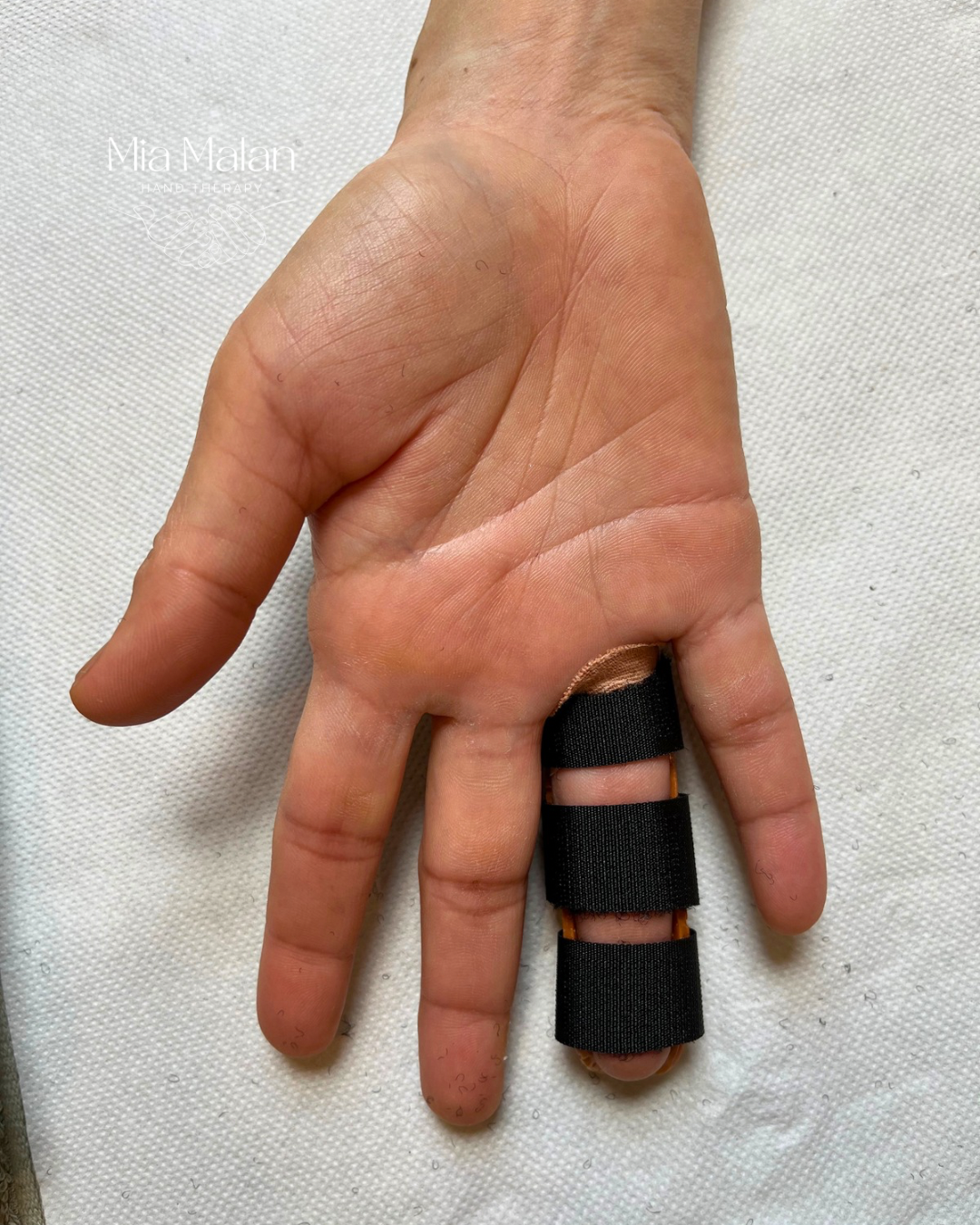
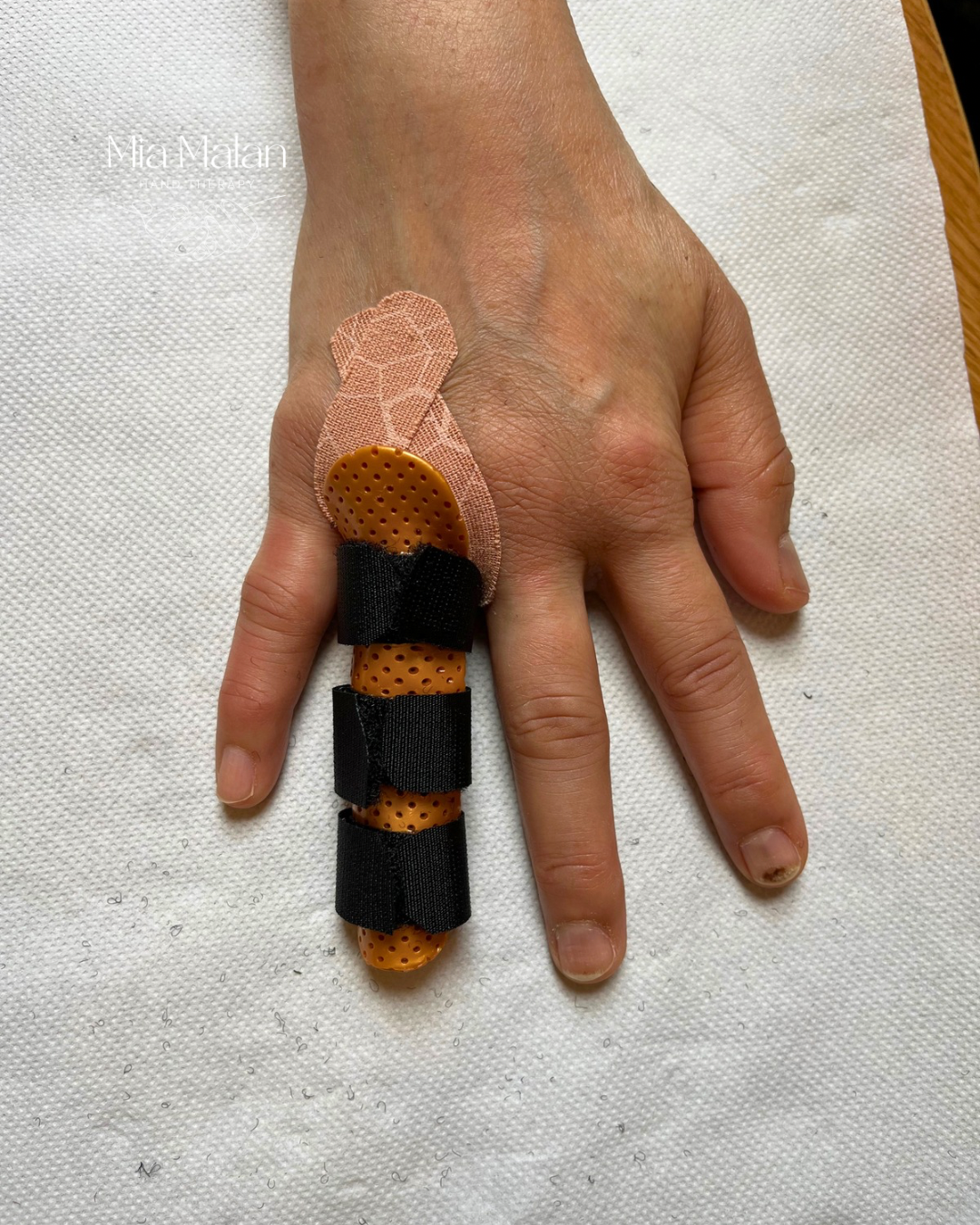
Protecting the injured ligament with a custom thermoplastic splint, which holds the joint in the right position while the ligaments heal
Buddy strapping — taping the injured finger to its neighbour for gentle support during movement
The goal at this stage is controlled rest, not total immobilisation. Keeping the finger completely still for too long is actually counterproductive; the structures need gentle movement to heal well.
Once the initial pain has settled, usually from around two weeks onwards, we shift the focus to guided movement. I'll take you through specific exercises designed to get the joint gliding again without overstressing the healing ligament. We work progressively — starting with small, pain-free ranges of motion and building from there.
For later presentations — the patients who come to me weeks or months down the track with a stiff, bent finger — treatment takes a bit longer and may involve more intensive splinting to stretch the scar tissue, alongside a structured exercise programme. These cases can still improve significantly; they just require more patience.
What Can You Expect?
Recovery from a finger dislocation is highly variable and depends on the severity of the injury, which joint is involved, and how quickly treatment begins. Here's a general guide:
Mild sprains and stable dislocations that are treated early often resolve well within four to eight weeks, with most function restored.
More significant ligament tears may take three to four months, and some residual swelling or stiffness can persist beyond that — fingers are notorious for staying puffy for a long time.
Neglected dislocations — the ones that have been stiffening up for weeks or months — can still respond well to hand therapy, but the rehabilitation is longer and the outcome more variable. This is exactly why I always say: earlier is better.
Throughout treatment, my job is not just to get your finger moving — it's to help you maintain as much hand function as possible while the healing happens. We keep you working, parenting, exercising, and living, with adaptations where needed.
A Word on “Walking It Off”
I completely understand the impulse to wait and see. Fingers feel like small problems. There's often a sense of toughness involved — "it's only a finger," or "I'll just tape it." And sometimes, genuinely mild sprains do settle on their own.
But the anatomy inside a finger joint is remarkably intricate. The ligaments, tendons, and joint capsule all interact. When one structure is damaged and not properly managed, others can compensate in ways that create secondary problems. What starts as a sore knuckle can quietly become a lasting limitation.
If your finger has been bothering you for more than two weeks after an injury — particularly if it's still swollen, difficult to straighten, or sitting in a slightly crooked position — that's your signal to get it assessed.
Ready to get it sorted? If you're based in Sydney and dealing with a finger that hasn't quite healed the way you hoped, I'd love to help. I see patients at Mia Malan Hand Therapy in Paddington, and I offer thorough, one-on-one assessments that get to the root of what's going on.
Book a consultation online — or reach out via Instagram @miamalanhandtherapy if you have questions first.
Mia Malan is an Occupational Therapist and Certified Hand Therapist specialising in upper limb injury rehabilitation and post-surgical care at her practice in Paddington, Sydney.
